


I discovered I was already dead on my third attempt at understanding Kelly Link’s “Valley of the Girls.”
The first read left me disoriented, dropped mid-conversation between girls named Hero, Alicia, and Stevie, talking about “faces” at school and building pyramids in cornfields. The second read made me angry—at Link for withholding, at myself for missing something. The third read followed a morning on Instagram, watching acquaintances perform sharper, shinier, louder versions of themselves than I’d met in person. That’s when the sentences snapped into focus. Link wasn’t describing a distant dystopia; she was showing us what we’re already becoming.
After three attempts, the unsettling impact of Link’s story became clear. “Valley of the Girls” begins with teenagers so rich they hire genetic surrogates for public life, but delivers something more precise: a cold dissection of what it means to buy the right to stop existing while appearing alive. The true horror isn’t Link’s science fiction. It’s that we’re already there, at lower resolution.
The Cognitive Blizzard Is the Point
Link disorients by design. As one reviewer said, the opening feels like falling through a wormhole. Hero, our narrator, discusses her “face” with the casual possession you’d use for a car: “My face was at school. My face went to the party. My face got drunk.” At first, “face” could be slang or a social handle. Then, one offhand clause clarifies everything. The face isn’t a metaphor. It’s a person—a better version, genetically perfected, who faces the dangers of visibility while you remain protected.
This choice—to disorient, then clarify—mirrors the characters’ dissociation. Hero doesn’t see her life as fragmented; it’s all she’s ever known. Everyone does it. The narrative confusion immerses us in her psychology: detached, observing, empty. We become complicit—we, too, spend opening pages viewing “the face” as an object before realizing it’s a person we’ve objectified.
I think about the hours I’ve spent curating my LinkedIn, Substack bio, and website—making sharper versions of myself perform competence while I sit behind the screen in sweatpants, second-guessing every word. The scale changes. The mechanism doesn’t.
The Central Horror Lives in a Single Sentence
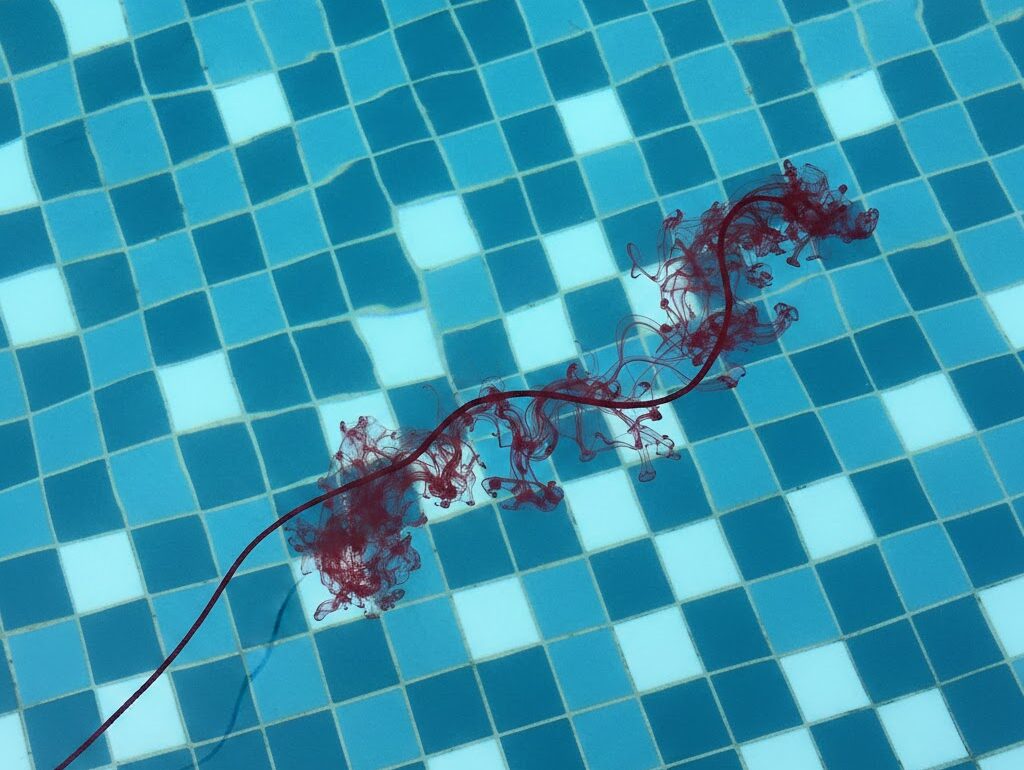
“I felt sorry for whoever was gonna have to clean up the pool.”
This line appears after Hero has cut her face, severing the connection—likely killing this girl, this person who was living Hero’s life better than Hero ever could. The face is injured, bleeding, and possibly dying. Hero has just committed what amounts to murder or at least severe assault. And her first thought, her only emotional response, extends not to the victim but to the custodial staff who will have to deal with the violence. The violence is aestheticized throughout—Hero sees “blooms of red” on tan skin, like flowers, like an art installation. Then she wonders if she’s voided the warranty. A human body reduced to a broken toaster. The sentence about the pool custodian encapsulates everything Link wants us to understand about extreme wealth. It creates such profound indifference that human death becomes a logistical problem for someone else to solve. else to solve.
Link described the story’s genesis as asking: if the rich get richer and richer, what kind of insane access would their children have? The answer she proposes inverts our celebrity-obsessed culture. Today, people are desperate to be seen—TikTok, YouTube, Instagram, the paparazzi economy runs on visibility. In “Valley of the Girls,” the ultimate status symbol is invisibility. You pay millions, so nobody knows what you actually look like. Your face—often genetically perfected—goes to school, takes the SATs, gets drunk at parties, and makes all the messy teenage mistakes. You remain hidden, safe, untouched.
The commodification isn’t just of the self but of the risk of being a self. Adolescence is inherently dangerous: you can be embarrassed, hurt, or kidnapped for ransom. These parents outsource the entire experience of living. The hierarchy is absolute: real girls at the top, faces at the bottom, with a clear transactional relationship between owner and property.
When Hero Meets Her Face
The confrontation scene demolishes any romantic notion about doubles. In most stories about doppelgängers—“Black Swan,” “Us,” “The Double”—there’s uncanny valley horror when they look too alike. Hero’s reaction is different, more disturbing:
“The face looked like my face. And then she was shinier, sharper.”
Those adjectives—shinier, sharper—belong to knives and new cars, not human beings. Hero continues: better legs, louder, rounder. Then the killer phrase: “the kind of girl you wanna die.”
That verb—“die”—carries extraordinary violence. It’s not “the kind of girl you want to be” or “the kind of girl you envy.” It’s “die.” Hero looks at her mirror-stage reflection, this ideal version of herself, and instead of identifying with it, she sees a product she owns and resents. The face is objectively more alive—louder, taking up more space in the world—and Hero simultaneously takes pride in having purchased such a superior avatar while feeling profound jealousy that someone else performs her life better than she ever could.

The dissociation is complete. Hero isn’t looking at a person. She’s considering an upgrade and can’t decide whether she’s proud or furious about the purchase.
The Death Cult in the Cornfields
The Egyptian mythology arrives like a non-sequitur until you realize it’s the essay’s thesis statement rendered in symbol. Link said in an interview that if you were invisible to the world but incredibly indulged, what weird hobbies would you have? Her answer: You’d buy. The title “Valley of the Girls” is a direct play on the Valley of the Kings. Pharaohs spent their entire lives preparing for death—building massive tombs, filling them with worldly wealth for the afterlife. That’s exactly what Hero and her friends do, literally constructing pyramids by hand in cornfields. They are, for all practical purposes, already dead. They’ve outsourced living to their faces and are ghosts haunting their own mansions. Their hobbies reflect that status: building their own tombs. The irony cuts deep. The face is out there, dating, learning, making friends, living—while the real girl stacks stones for her own grave. Pyramids are static, heavy, permanent—the opposite of the shiny, sharp, dynamic, messy life of the face. By focusing on tomb construction, the girls embrace their own obsolescence. They’re actively choosing to be monuments rather than people. In ancient Egyptian mythology, preserving the body ensured the soul’s survival in the afterlife. Link inverts this. The girls preserve their bodies in gilded cages while destroying the life force embodied by the face. It’s a total perversion: they get physical safety and spiritual death. spiritual death.
The Protagonist Who Isn’t There
Hero is a classic unreliable narrator, not because she actively lies but because she’s fundamentally empty. Her voice is detached and observant but lacks empathy. She knows on some level that she’s the lesser version. There’s one moment of painful self-awareness where she admits: “I saw that she was, what eyes have looked like if my face had ever met all of us.”
That syntax breaks because her sense of self is fracturing. She recognizes the absolute superiority of the copy she created.
On the other side, the face feels more like the protagonist than Hero does. In traditional narrative structure, the protagonist is active, faces conflict, has desires, and seeks connection. The face does all of this. There’s a heartbreaking moment where she tries to establish shared history: “Don’t you remember the watermelons? I thought we were gonna have a serious talk.”
The face is reaching out. She’s asserting personhood, trying to establish that she has memories, feelings, and an interior life. Hero completely shuts it down, suppresses the memory. She has to reject it because if she acknowledges that the face has consciousness, has memories, has genuine relationships, then Hero has to confront that she’s enslaving a sentient being.
The dialogue throughout the story reflects this refusal. It’s clipped, loaded with unspoken violence. The cord scene is the clearest example:
“Gimme the cord.”
“It hurts really bad.”
“Gim, there’s no engagement with the face’s pain. No “What hurts?” or “Why?”—just a repetition of the command. It’s not a conversation. It’s a master disciplining a dog. Or, more accurately: a user troubleshooting a malfunctioning device. “Alexa, stop.” “Give me the cord.” Give me the cord.”
The Linguistic Virus We Need to Quarantine
Link said her work explores how technology and modernity complicate the old predicaments of being human. That feels like the heart of it. We live in a society obsessed with curation. We curate Instagram feeds, LinkedIn profiles, digital avatars in virtual worlds, and now AI agents trained on our writing to respond like us. We all, in a way, create digital faces that are shinier and sharper versions of our real, messy lives.
Link takes this to its logical, horrifying conclusion. She asks: What happens when the image becomes so polished and so important that the person who created it becomes unnecessary?
The MacArthur Foundation called the story an “inevitable tragedy,” and the tragedy isn’t just that the face gets hurt or killed. The true tragedy is the narrator’s spiritual death. Hero survives physically. She stays safe behind the gates. She gets to build her little pyramid in the cornfield. But she hasn’t lived. She’s perfectly preserved the container while completely emptying out the contents.
I think about my own digital doubles—the professional persona on LinkedIn performing expertise, the Substack writer performing insight, the conference version of myself performing confidence. These aren’t genetically modified surrogates, but they’re performing a version of life I’m not fully inhabiting. Every hour spent curating them is an hour not spent living in unmediated reality.
The seduction is powerful: wouldn’t it be easier if the avatar could handle the networking event, the difficult conversation, the awkward Thanksgiving dinner? If I could train an AI agent to write my emails, respond to messages, and eventually draft my essays in my style while I… what? Sit in my fortress? Build my pyramid?
The Pool Is Already Full
The most devastating aspect of Link’s story is that we don’t need the science fiction. We’re already outsourcing our humanity, just at a lower resolution. We’re building pyramids of content that will outlast us—digital tombs we construct while we’re still alive. We’re creating faces that perform our lives while we watch from behind screens, growing increasingly dissociated from unmediated experience.
The warning isn’t about some future technology. It’s about the technology we’re holding right now, the avatars we’re already building, the automation we’re already implementing. Every layer of mediation between us and reality is a small death. Every task we outsource to an algorithm is a piece of our humanity we declare unnecessary.
What Kelly Link understood in 2015—and what becomes more urgent with each passing year—is that you can’t purchase safety from the risk of being human without purchasing your own obsolescence. The girls in the cornfields building pyramids aren’t preparing for death. They’re already dead. They just haven’t noticed yet because their faces are still out there, laughing louder, taking up more space, living the lives their owners have abandoned.
The pool is filling up. The bodies are dropping. And somewhere, someone will have to clean it up—someone whose humanity we’ve decided doesn’t require our concern, whose existence we’ve reduced to logistical inconvenience.
The question isn’t whether we’ll end up like Hero, empty and entombed. The question is whether we’ll notice before we’ve finished building the pyramid, before we’ve severed the last cord connecting us to the messy, vulnerable, terrifying experience of actually being alive.
I return to that single sentence: “I felt sorry for whoever was gonna have to clean up the pool.” Read it again. Feel its profound indifference. Then ask yourself: how many pools are you ignoring? How many cords have you already cut? And whose face is living your life while you sit safely inside, stacking stones in the dark?